Skip to content
Chickeninja

Hollywood stabilization.
Less than 1 pound.

A motorized fourth axis that mechanically erases vertical bounce. No dolly. No chase car. No gravity-offload suit. No "ninja walk" necessary.

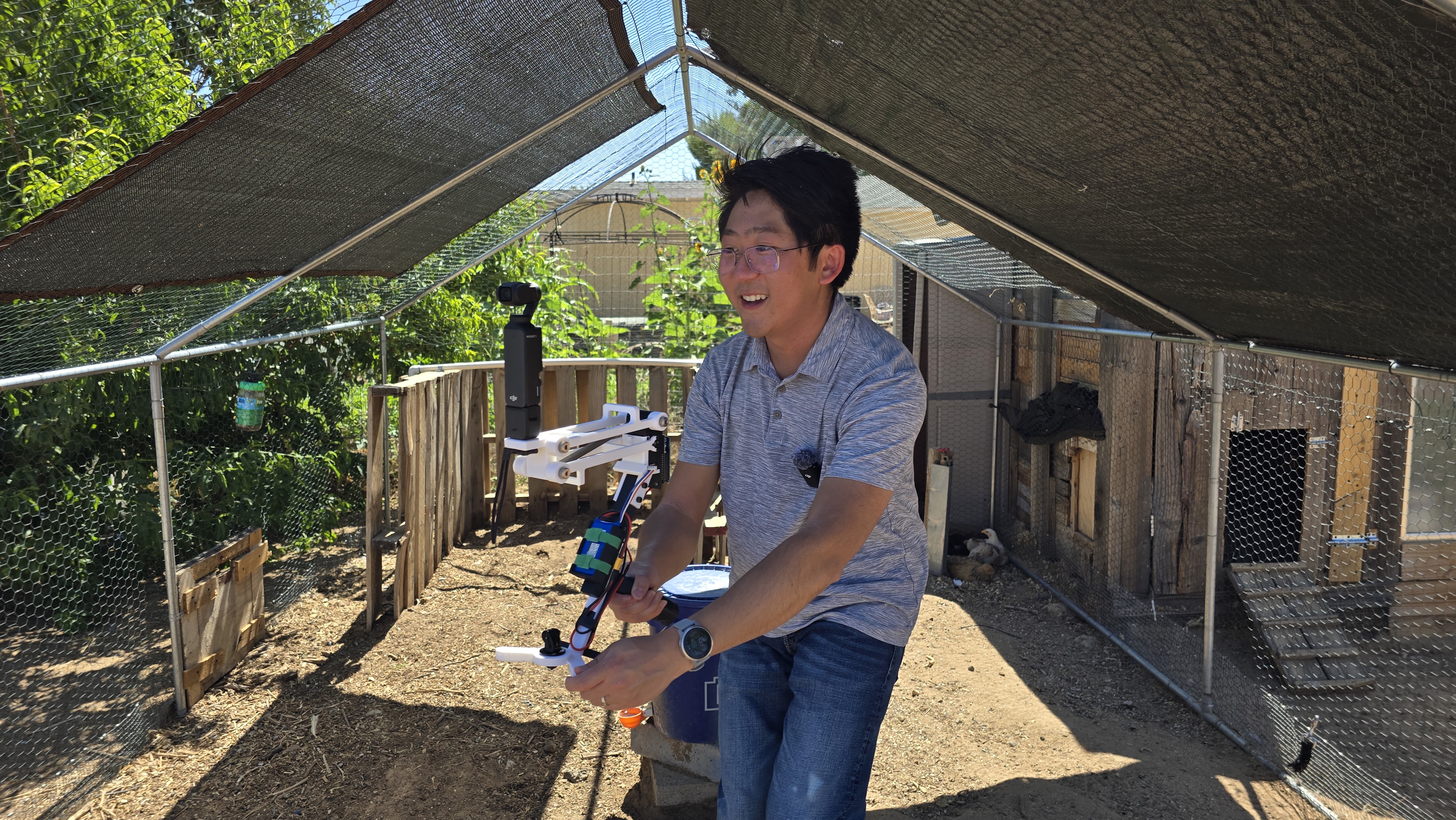
The Chickeninja rig in use: a white 3D-printed stabilizer carrying a DJI Osmo Pocket 3, handheld inside a sunlit backyard chicken coop.
Target price
~$199
Replaces
20–50 lb rigs
Status
Provisional patent filed

Your gimbal fixed the wrong problem.

A 3-axis gimbal corrects rotation — pitch, roll, yaw. It cannot correct translation. So when you walk, the whole rig still rides your footsteps up and down. That residual vertical bounce is the thing that reads as "handheld," and it's why the industry throws dollies, chase cars, moving platforms and 50 lb gravity-offloading suits at it.

01

3 axes of rotation

Pitch, roll and yaw. Solved a decade ago, and solved well. Every consumer gimbal does this.

02

1 axis of bounce

Vertical translation — the Z axis. Left uncorrected on essentially every handheld rig you can buy.

03

The chicken's trick

A chicken's body bobs while its head stays perfectly still, held by a linkage of neck vertebrae. Chickeninja does the same thing for your camera, with just a motor and a robot brain.

Eliminate the ninja walk.

Same footsteps, same grip motion. Toggle the fourth axis and watch what reaches the sensor.

HORIZON GRIP CAMERA
Vertical position over time Your hand Camera

Camera travel: ±50 mm — rig rides every footstep

Illustrative simulation of the linkage geometry, not measured field data.

Built to disappear into the shoot.

Every design decision serves one goal: less time fighting your gear, more time on the scene.

3-second calibration

Power on, hold still, shoot. No app, no wizard, no waiting on the tripod.

Zero rebalancing

Swap from a phone to a mirrorless mid-shoot. The system doesn't need to be re-trimmed for the new payload.

Works in pitch darkness

Inertial sensing, not optical tracking. There is nothing for the system to lose sight of — and unlike a real chicken, it doesn't need the lights on.

2+ hour runtime

Longer than the battery in whatever you mounted on top of it. One charge covers the shoot.

Universal payload

Smartphones, GoPros, the DJI Osmo Pocket 3, and small mirrorless bodies all mount up.

0.98 lbs, backpack-sized

3D-printed PLA chassis with commodity motors and sensors. Carry it on the hike in, not in a van.

What it replaces.

Legacy Z-axis solutions all work. They just cost a car and need a crew.

Comparison of Z-axis stabilization approaches by cost, weight and setup
Approach Typical cost Weight / footprint Works in the dark
Dolly & track $10k–$100k+ Needs laid track and a crew Yes, but you can't leave the track
Chase car / platform $10k–$100k+ A vehicle Roads only
Gravity-offload vest Thousands 20–50 lbs, worn Yes, plus trained operator
3-axis gimbal alone $100–$1k Light Doesn't address Z at all
Chickeninja ~$199 0.98 lbs, fits in a backpack Yes — inertial, no optics

Engineered for creators.

A 3D-printed PLA chassis, off-the-shelf motors and sensors, and a linkage that does the hard part.

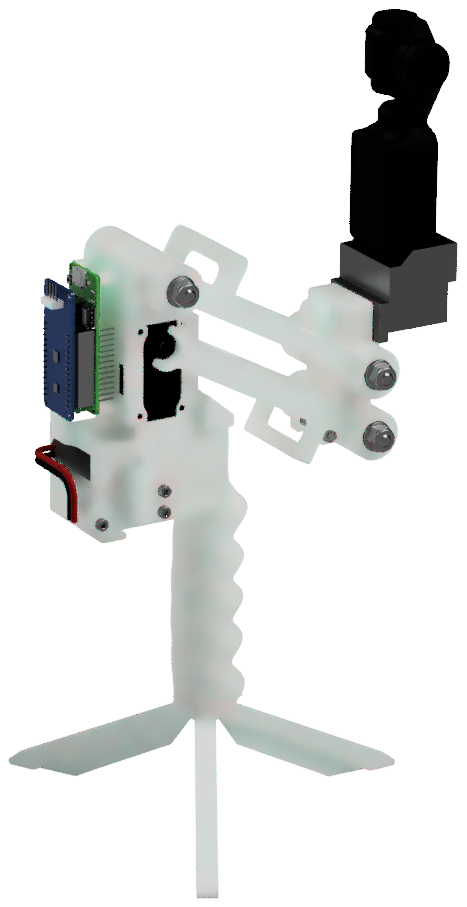
CAD render of the Chickeninja showing the control board, motor, four-bar linkage and camera plate.
3D CAD render, showing the control board, motor, four-bar linkage and camera plate

What we're optimizing for.

Frictionless creativity

Ultra-fast setup, universal compatibility, extreme portability. You should be thinking about your scene, not your rig.

Democratization of tech

Cinema-grade Z-axis capability at a fraction of the traditional cost. The shot shouldn't require the budget.

Agility & freedom

Lightweight and adaptable, so you can shoot on any terrain, in any light, without asking permission from your equipment.

From a mechanical hunch to a working rig.

The goal has never changed: render bulky, expensive legacy stabilization obsolete for the modern shoot.

  1. 2025

    Mechanical prototyping

    First linkages, first motors, first proof that a chicken's neck is a serviceable engineering reference.

  2. 2025

    Provisional patent filed

    The active Z-axis mechanism, on the record.

  3. Summer 2026

    Interactive exhibit at Open Sauce

    Hundreds of people picked it up, walked with it, and watched their own footsteps vanish from the footage.

  4. Next

    Getting it into your backpack

    Production engineering and a first run. The waitlist is how you hear about it first.

Questions.

Does this replace my gimbal?

No — it completes it. Your gimbal handles the three rotational axes. Chickeninja adds the fourth, vertical translation, which gimbals structurally can't correct.

How does it work without a camera or tracking markers?

An IMU measures the rig's own acceleration directly, and the motor drives the linkage to cancel it. Nothing is being watched, so nothing can be lost — it behaves the same at noon and at midnight.

What can I mount on it?

Smartphones, GoPros, the DJI Osmo Pocket 3, and small mirrorless bodies. Because there's no counterweight trimming, switching payloads doesn't cost you a rebalance.

Is it really $199?

That's the target price, and it's achievable because the chassis is printed PLA and the motors and sensors are commodity parts. Final pricing lands with the first production run.

When can I buy one?

Not yet — we're in production engineering after exhibiting at Open Sauce. Join the waitlist and you'll hear before anyone else.

Join the Chicken Coop.

Production updates and early access. No noise.

We won't send you spam. Unsubscribe at any time.